How To Reword A Sentence That Ends In A Preposition : Предлог в конце предложения. Ending a sentence with a ... - The word preposition is translated to place before.
on
Get link
Facebook
X
Pinterest
Email
Other Apps
How To Reword A Sentence That Ends In A Preposition : Предлог в конце предложения. Ending a sentence with a ... - The word preposition is translated to place before.. Nevertheless, it is possible to rephrase them (often by placing the preposition at the beginning of the sentence). Simply saying who is this pink sweater won't make any sense. (this is an example of how to reword a sentence so as to not end with a preposition). So go forth and end sentences with prepositions, but only when it makes sense to do so. There is no preposition at the end of that sentence.
Even if there were a rule that a sentence can't be ended with a preposition (there isn't), some sentences must be ended with a preposition. Without further context, yours is one of them. For example, when you say something like who is this pink sweater for? you have to use the for in the end to complete the sentence. Ending a sentence with a preposition: In the prepositional phrase to the moon, the preposition is to and the object is moon. in the phrase at the park, the preposition is at and the object is park.
Where Did the "No Prepositions at the End of a Sentence ... from www.wonderopolis.org Most prepositional phrases modify a noun or verb, often called adjectival or adverbial phrases, respectively. Final prepositions can occur at the end of sentences with infinitive or passive grammatical structures. Luckily for those poor, persecuted prepositions, that just isn't true. You should leave it off. Here are a few preposition guidelines: It is fine to end a sentence with a preposition; B) you are reading the book in which my article was published. For example, when you say something like who is this pink sweater for? you have to use the for in the end to complete the sentence.
The preposition should go before the noun or pronoun which acts as its object.
Of course, ending a sentence with a preposition doesn't lend itself to that too often but if you are careful to not end sentences that way, then one of your characters could end a sentence with prepositions and dangling participles, creating a very unique voice. For example, i often hear people ask, where did you go to? The problem is that sentence a ends with the preposition in, while sentence b places the preposition in the middle of the sentence. Reword the english so it doesn't end in a preposition, and then translate. For someone who holds this view, sentence a below would be wrong: In fact, it's fine to end a sentence with a preposition, and most of us do it at some point. However, the first sentence is a totally different situation. You should leave it off. There is a good chance that if you reword your sentence to avoid a preposition at the end, it will be a better, more succinct sentence. Here are a few preposition guidelines: The word preposition is translated to place before. However, regardless of the formalness of the situation, many times we end sentences with prepositions when we could easily reword the sentence. Simply saying who is this pink sweater won't make any sense.
A prepositional phrase contains a preposition and an object. Of course, ending a sentence with a preposition doesn't lend itself to that too often but if you are careful to not end sentences that way, then one of your characters could end a sentence with prepositions and dangling participles, creating a very unique voice. When they're the object of the sentence, you can omit the pronoun — but this often results in a dangling preposition. So go forth and end sentences with prepositions, but only when it makes sense to do so. Ending a sentence with a preposition a preposition typically sits before a noun to show the noun's relationship with another nearby word.
Can you end a sentence with a preposition | Lexico from i.pinimg.com Note that in formal communication (such as a job application or a statement of purpose), people often rewrite sentences to avoid such usage. However, the first sentence is a totally different situation. You should leave it off. Remember, your intended meaning governs the change. You can avoid this issue with improved word choice, e. Nevertheless, it is possible to rephrase them (often by placing the preposition at the beginning of the sentence). Most prepositional phrases modify a noun or verb, often called adjectival or adverbial phrases, respectively. (this is an example of how to reword a sentence so as to not end with a preposition).
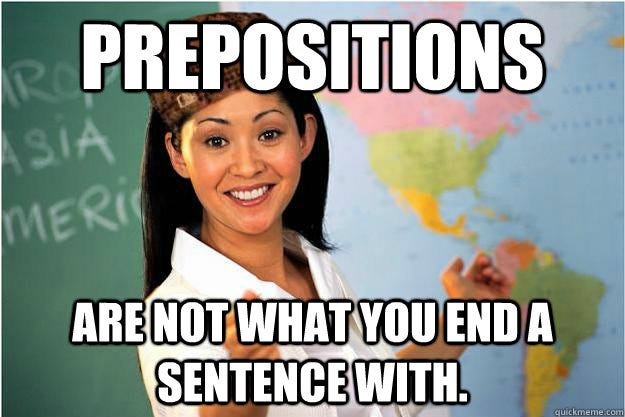
It is perfectly formal and 100% correct.
You should never end a sentence with a preposition! I wish he would cheer up. The more important conversation here is about writing clear sentences. You can avoid this issue with improved word choice, e. A prepositional phrase contains a preposition and an object. Cheer up, run over, log on, and leave off are all examples of phrasal verbs, and often sentences that use phrasal verbs end with a preposition: B) you are reading the book in which my article was published. Most prepositional phrases modify a noun or verb, often called adjectival or adverbial phrases, respectively. (a complete sentence indicating that the person to whom one is speaking is aware of the time of lunch. Without further context, yours is one of them. You know what time lunch is. When of collocates with take advantage, an idiomatic preposi. The word preposition means sited before. so, as prepositions are designed to sit before nouns, there is some logic to the ruling that a preposition can't be at the end of a sentence.
And the sentence would make sense without over. The corrected sentences above sound stupid. The preposition should go before the noun or pronoun which acts as its object. There are of course other ways to translate those english sentences, and there are approximately 3.2 bajillion other english sentences ending with about, of, and other prepositions. The more important conversation here is about writing clear sentences.
Let's go myth-busting! - I Love Charts - Medium from cdn-images-1.medium.com Here are a few examples, with each prepositional. So go forth and end sentences with prepositions, but only when it makes sense to do so. There are of course other ways to translate those english sentences, and there are approximately 3.2 bajillion other english sentences ending with about, of, and other prepositions. You should never end a sentence with a preposition! The goal is crafting a sentence that's shorter, better, and works within your context. A) you are reading the book which my article was published in. It is fine to end a sentence with a preposition; When they're the object of the sentence, you can omit the pronoun — but this often results in a dangling preposition.
However, regardless of the formalness of the situation, many times we end sentences with prepositions when we could easily reword the sentence.
In fact, it's fine to end a sentence with a preposition, and most of us do it at some point. Ending a sentence with a preposition such as with, of, and to, is permissible in the english language. Here are a few examples, with each prepositional. The problem is that sentence a ends with the preposition in, while sentence b places the preposition in the middle of the sentence. It is fine to end a sentence with a preposition; Typically, to avoid ending a sentence with a preposition, you place the preposition before the connector word. However, regardless of the formalness of the situation, many times we end sentences with prepositions when we could easily reword the sentence. The preposition should go before the noun or pronoun which acts as its object. He eats dinner after he goes running. Ending a sentence with a preposition a preposition typically sits before a noun to show the noun's relationship with another nearby word. (a complete sentence indicating that the person to whom one is speaking is aware of the time of lunch. A) you are reading the book which my article was published in. There are some sentences where a preposition has to come at the end in order for the sentence to make sense.


Comments
Post a Comment